Introduction #
Smart Money Concepts (SMC) is a professional trading methodology focused on understanding institutional order flow and price delivery.
Unlike traditional retail trading methods that rely heavily on lagging indicators, SMC helps traders read the market through liquidity, market structure, and institutional behavior.
Table of Contents #
- What is Smart Money?
- Market Structure
- Break of Structure (BOS)
- Change of Character (CHoCH)
- Order Blocks (OB)
- Fair Value Gaps (FVG)
- Liquidity
- Inducement (IDM)
- Supply and Demand Zones
- Premium and Discount Zones
- Optimal Trade Entry (OTE)
- Crypto Session Timing
- Multi-Timeframe Analysis
- Risk Management
- Common Mistakes
- SMC Trading Checklist
- Glossary
What is Smart Money? #
Smart Money refers to institutional participants such as:
- Banks
- Hedge funds
- Market makers
- Institutional traders
These entities have the capital and liquidity required to move the market.
Smart Money Market Cycle #
Accumulation #
Institutions quietly build positions while price moves sideways.
Manipulation #
False breakouts and stop hunts trap retail traders.
Expansion #
Price aggressively moves in the intended institutional direction.
Market Structure #
Bullish Market Structure #
- Higher Highs (HH)
- Higher Lows (HL)
As long as price continues making HH and HL, focus on buy setups.
Bearish Market Structure #
- Lower Highs (LH)
- Lower Lows (LL)
As long as price continues making LH and LL, focus on sell setups.
Break of Structure (BOS) #
Break of Structure confirms trend continuation.
Bullish BOS #
Price breaks above a previous swing high.
Bearish BOS #
Price breaks below a previous swing low.
Important BOS Rules #
- Candle body must close beyond the level
- Wicks alone do not confirm BOS
- Higher timeframe BOS is more significant
Change of Character (CHoCH) #
CHoCH signals a possible trend reversal.
Bullish CHoCH #
In a downtrend:
- Price breaks above the recent Lower High (LH)
Bearish CHoCH #
In an uptrend:
- Price breaks below the recent Higher Low (HL)
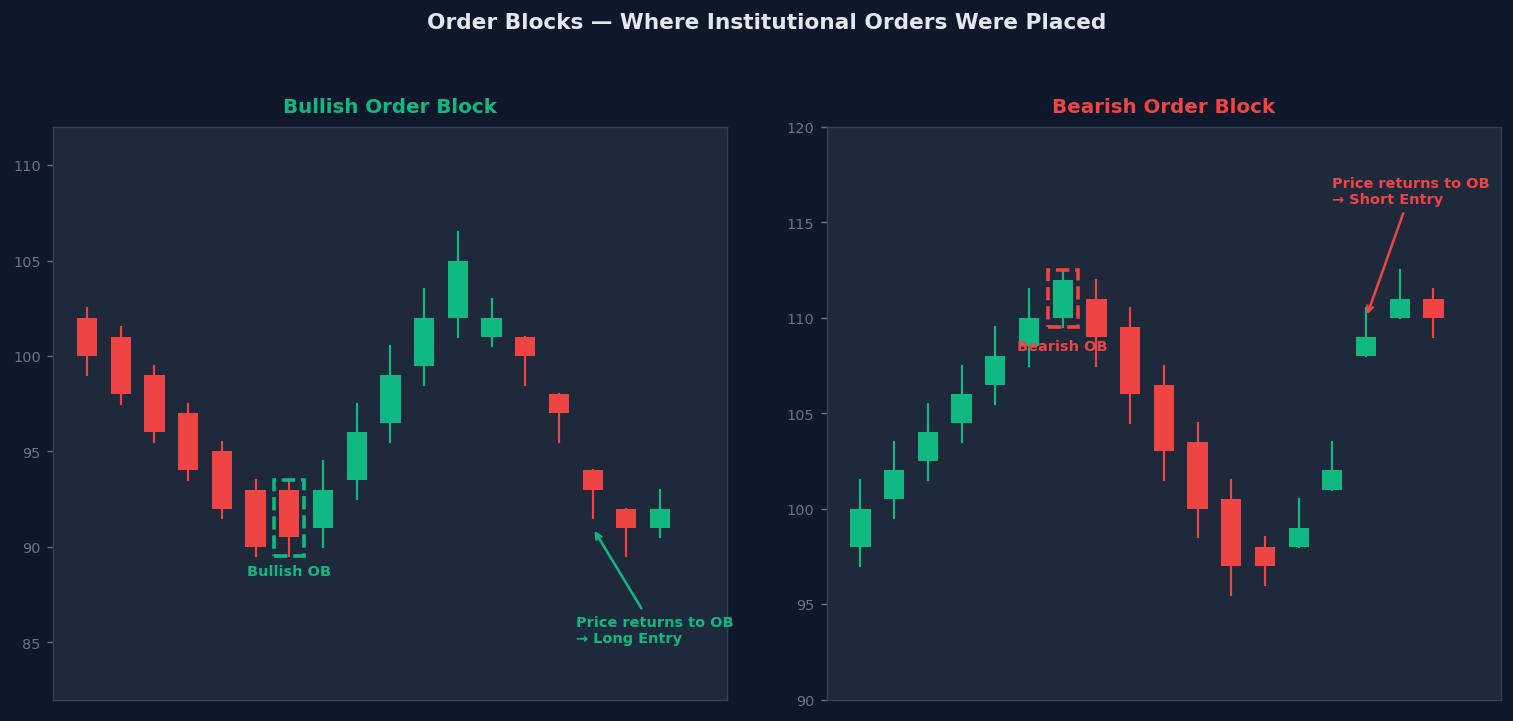
Order Blocks (OB) #
An Order Block is the final candle before a strong impulsive move.
Bullish Order Block #
The last bearish candle before strong bullish expansion.
Bearish Order Block #
The last bullish candle before strong bearish expansion.
Valid Order Block Rules #
- Must create BOS
- Should contain nearby imbalance or FVG
- Must be unmitigated
- Higher timeframe OBs are stronger
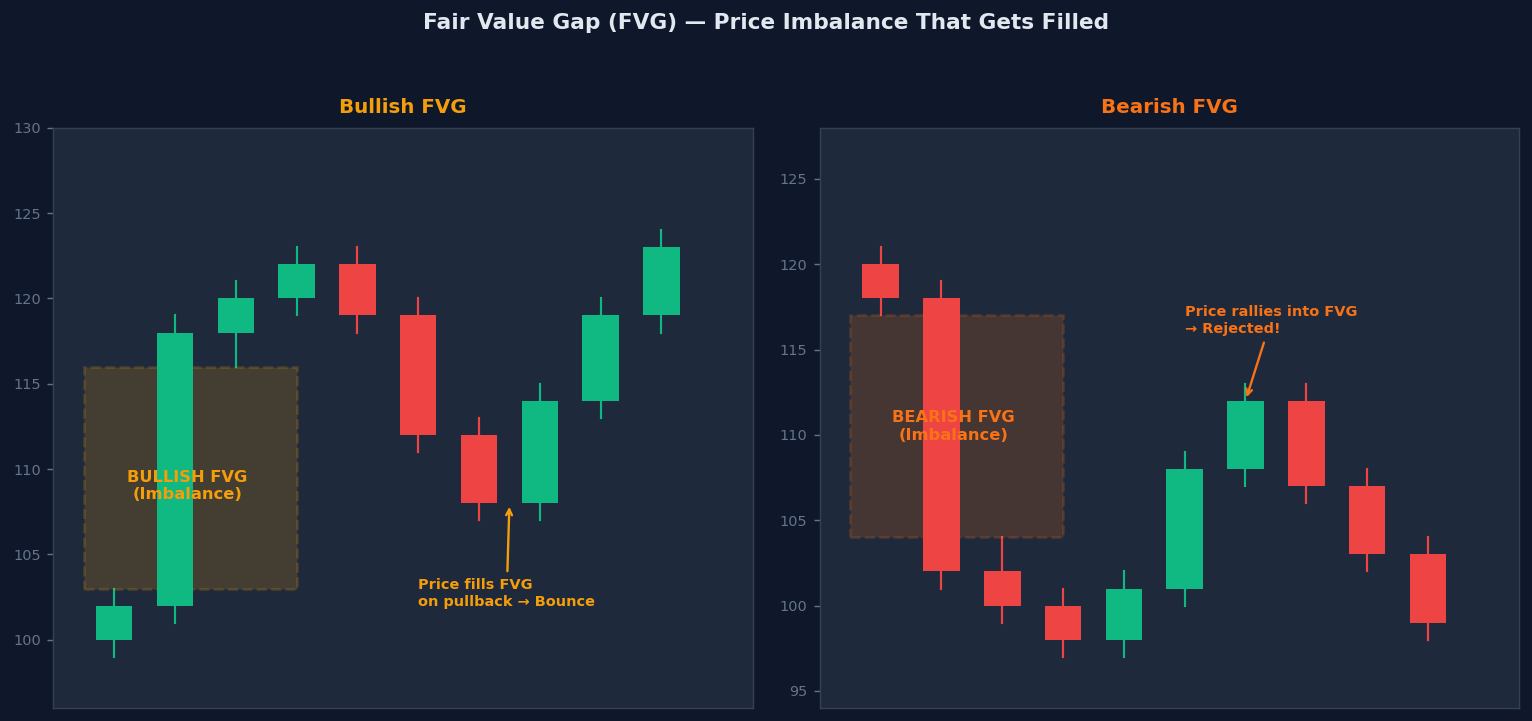
Fair Value Gaps (FVG) #
Fair Value Gaps are price imbalances created by aggressive institutional movement.
Bullish FVG #
Gap between:
- Candle 1 High
- Candle 3 Low
Bearish FVG #
Gap between:
- Candle 1 Low
- Candle 3 High
High Probability Setup #
Strong confluence occurs when:
- Order Block
- Fair Value Gap
- Liquidity Sweep
align together in the same area.
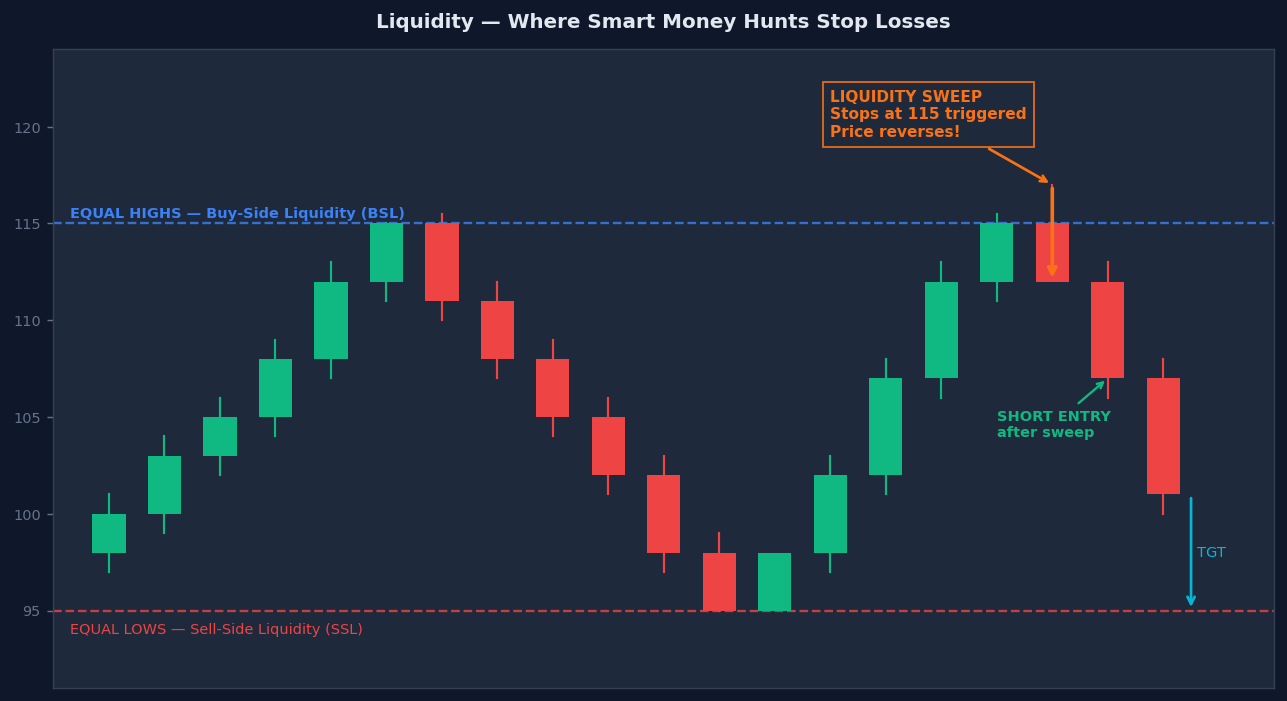
Liquidity #
Liquidity is where stop losses and pending orders exist.
Smart Money targets liquidity to fill large institutional positions.
Types of Liquidity #
Buy-Side Liquidity (BSL) #
Liquidity resting above highs.
Sell-Side Liquidity (SSL) #
Liquidity resting below lows.
Equal Highs (EQH) #
Liquidity pool above price.
Equal Lows (EQL) #
Liquidity pool below price.
Inducement (IDM) #
Inducement is a deliberate false move within internal structure designed to trap retail traders before the real move.
How it works:
Institutions create a small liquidity pool by letting price make a false internal break (a minor BOS or CHoCH). Retail traders see this and enter in the wrong direction. Institutions then use those retail positions as liquidity to fuel the actual move in the opposite direction.
Example:
Price is in a downtrend. A small internal rally breaks above a minor lower high — this looks like a CHoCH to retail traders who buy. Institutions then sell into those buyers, sweep their stop losses above, and continue the downtrend.
How to avoid:
- Only trade CHoCH/BOS that breaks a significant external structure level, not a minor internal swing
- Wait for a retracement to a valid OB or FVG before entering — not the first move after a structural break
- If a “reversal” breaks with low momentum and immediately stalls, treat it as potential inducement
Supply and Demand Zones #
Premium and Discount Zones #
Institutions prefer:
- Buying at discount
- Selling at premium
Equilibrium Rule #
- Above 50% = Premium
- Below 50% = Discount
Optimal Trade Entry (OTE) #
Professional institutional retracement levels:
- 0.618
- 0.705
- 0.786
These Fibonacci levels are commonly used for high probability entries.
Crypto Session Timing #
| Session | Timing (IST) |
|---|---|
| Asian Session | 5:30 AM – 2:00 PM |
| London Open | 1:30 PM – 5:00 PM |
| New York Open | 6:30 PM – 10:00 PM |
| London Close | 10:30 PM – 12:00 AM |
Multi-Timeframe Analysis #
| Timeframe | Purpose | Examples |
|---|---|---|
| HTF | Trend & Liquidity | Daily, 4H |
| ITF | BOS, CHoCH, OBs | 1H, 15M |
| LTF | Entries & Confirmation | 1M, 5M |
Golden Rule #
Never trade against the higher timeframe trend.
Risk Management #
Risk Rules #
- Risk only 1–2% per trade
- Maintain minimum 1:2 Risk Reward
- Move stop loss to breakeven after partial profit
Position Sizing Formula #
Position Size = (Account Balance × Risk %) / Stop LossExample:
$10,000 Account
1% Risk = $100
$700 Stop Loss (1% of BTC at $70,000)

$100 ÷ $700 = 0.143 BTC position size
Common SMC Mistakes #
- Trading without higher timeframe context
- Ignoring liquidity
- Over-leveraging
- Revenge trading
- Trading every Order Block blindly
- Entering without confirmation
SMC Trading Checklist #
Pre-Trade #
- Higher timeframe trend identified
- Liquidity levels marked
- Order Blocks and FVGs identified
- Market structure confirmed
Entry #
- BOS confirmation
- Price at valid POI
- Lower timeframe confirmation
- Proper risk management
Execution #
- Trade during active session
- No emotional trading
- Follow predefined plan
Glossary #
| Term | Meaning |
|---|---|
| BOS | Break of Structure |
| CHoCH | Change of Character |
| OB | Order Block |
| FVG | Fair Value Gap |
| BSL | Buy-Side Liquidity |
| SSL | Sell-Side Liquidity |
| IDM | Inducement |
| OTE | Optimal Trade Entry |
| POI | Point of Interest |
Final Thoughts #
Smart Money Concepts is not a shortcut to trading success.
It is a structured way to understand:
- Institutional order flow
- Liquidity movement
- Market structure
- Price delivery
Master the foundations first:
- Market Structure
- BOS
- CHoCH
- Liquidity
- Order Blocks
- Fair Value Gaps
Then combine them into a complete trading model.
Disclaimer #
I am not a financial advisor.
This content is for educational purposes only.
Crypto trading involves substantial risk. Always do your own research and manage risk properly.